

Produkte aus Klammern auflösen (Summe mal Summe)
Einstieg
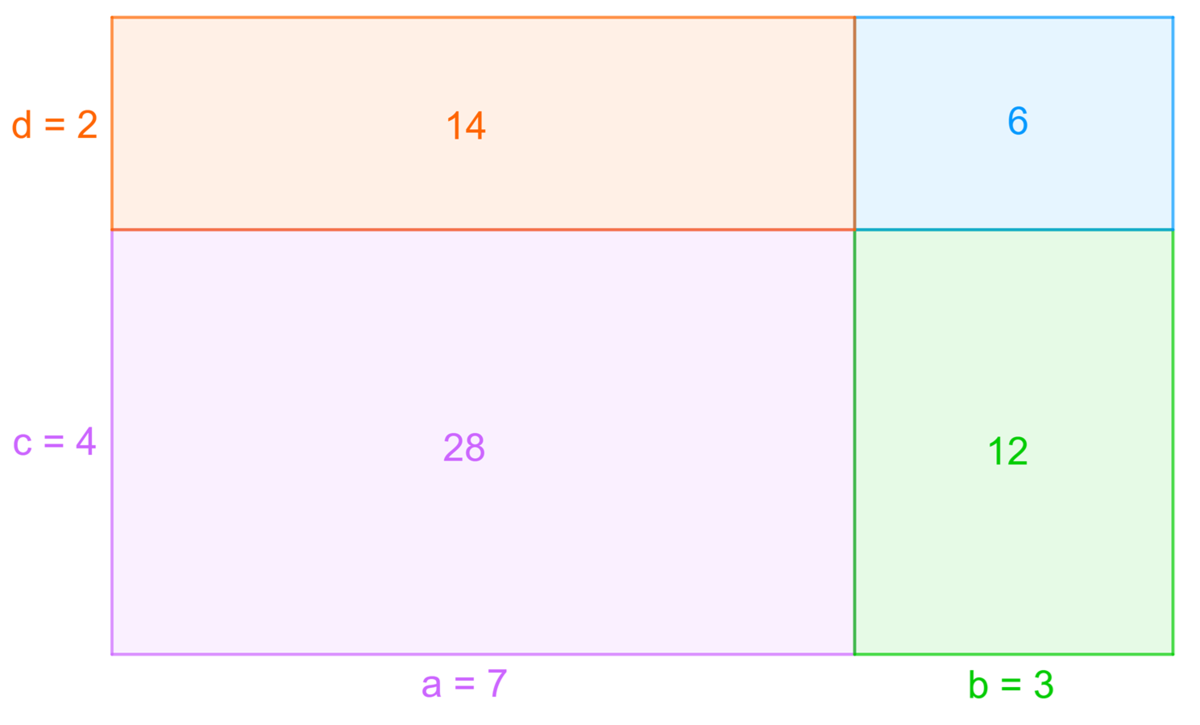
Für ein Schülerpuzzle soll ein großes Rechteck vorbereitet werden. Die Bildbereiche lassen sich in vier rechteckige Bereiche einteilen. Für den Prototyp werden diese aus farbigen Karton gebastelt.
Die Schüler Maria, Markus und Melanie verfolgen verschiedene Herangehensweisen, um die Größen der Bildbereiche und die Gesamtgröße zu ermitteln.
a) Begründe, welche Schüler mit ihrer Rechnung richtig liegen und beschreibe das jeweilige Vorgehen.
b) Formuliere jeweils einen Term, der die richtigen Lösungen miteinander vergleicht.
Maria | Markus | Melanie |
|---|---|---|
| \[A_1 = 7 \cdot 4 = 28 \ cm^2\] | \[A = 10 \cdot 6 = 60\ cm^2\] | \[A_1 = 10 \cdot 4 = 40\ cm^2\] |
| \[A_2 = 3 \cdot 4 = 12\ cm^2\] | \[A_2 = 10 \cdot 2 = 20\ cm^2\] | |
| \[A_3 = 7 \cdot 2 = 14\ cm^2\] | ||
| \[A_4 = 3 \cdot 2 = 6\ cm^2\] | ||
| \[A_{Ges} = 60\ cm^2\] | \[A_{Ges} = 60\ cm^2\] | \[A_{Ges} = 60\ cm^2\] |
Alle Schüler liegen richtig
| Maria: | Berechnung der vier Teilrechtecke, anschließend Flächen summieren. |
| Markus: | Fläche als ein großes Rechteck. |
| Melanie: | Jeweils zwei Flächen zusammen als ein Rechteck. |
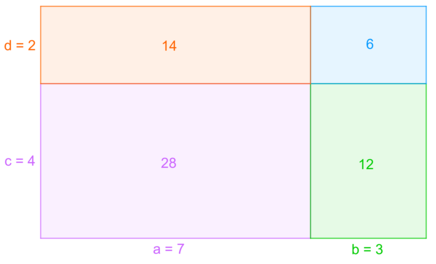
| Maria: | \[A = ac + ad + bc + bd\] |
| Markus: | \[A = (a+b) \cdot (c+d)\] |
| Melanie: | \[A = (a+b) \cdot c + (a + b) \cdot d\] |
Erarbeitung
| \[\huge (a+b)(c+d)\] |
| \(\huge=\) |
| \(\huge=\) |
| \(\huge=\) |
| \(\huge=\) |
\(\Large \left(a+b\right)\cdot \left(c + d\right) = \)
\(\Large \left(a-b\right)\cdot \left(c + d\right) = \)
\(\Large \left(a+b\right)\cdot \left(c - d\right) = \)
\(\Large \left(a-b\right)\cdot \left(c - d\right) = \)
\(\Large \left(y+3\right)\cdot \left(x + 2\right) = \)
\(\Large \left(2x - 4\right)\cdot \left(3x - 2\right) = \)
\(\Large \left(5y + 2z\right)\cdot \left(x + 2a\right) = \)
\(\Large \left(-4x -1\right)\cdot \left(3x +1 \right) = \)
Merkkasten [TIMER:360]
Aufgabe 1: Übertrage den Merkkasten in dein Heft.
Erklärung: Summe mal Summe
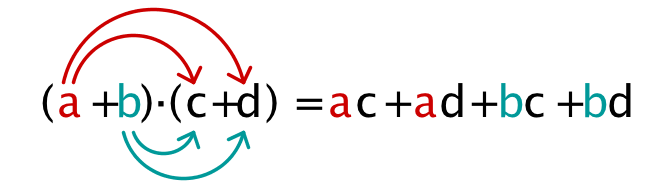
Bei der Multiplikation von zwei Binomen wird jeder Summand des einen Binoms mit jedem Summanden des anderen Binoms multipliziert.
\[\Large (a+b)\cdot (c+d) = ac + ad + bc + bd\]
Aufgaben / Übung [TIMER:1200]
Aufgabe 2: Löse die Klammern auf und vereinfache.
| a) \((x + 2)(x + 3)\) | b) \((x - 4)(-x + 5)\) |
| c) \((-x + 1)(x – 6)\) | d) \((x - 2)(-x - 3)\) |
| e) \((-x + 4)(-x + 1)\) | f) \((3x - 5)(2x + 2)\) |
| g) \((-4x + 6)(2x - 1)\) | h) \((3x - 3)(-3x - 4)\) |
| i) \((2x + 3)(-6x + 4)\) | j) \((-x - 2)(2x + 6)\) |
| k) \((3x + 5)(x - 3)\) | l) \((4x - 1)(x - 5)\) |
| m) \((x + 2)(-2x + 7)\) | n) \((-x - 6)(-3x + 3)\) |
| o) \((x + 1)(x - 7)\) | p) \((x - 4)(x - 2)\) |
Aufgabe 3: Löse die Klammern auf.
| a) \((2x + 3y)(4x - 5y)\) | b) \((6x - 7y)(x + 2y)\) |
| c) \((3x + y)(2x - 9y)\) | d) \((5x - 4y)(x - y)\) |
| e) \((x + 8y)(3x + 7y)\) | f) \((7x - 2y)(4x + 6y)\) |
| g) \((2x + 9y)(x - 3y)\) | h) \((x - 8y)(5x - 4y)\) |
| i) \((3x + 4y)(2x + 5y)\) | j) \((4x - 9y)(6x + y)\) |
| k) \((x + 5y)(7x - 3y)\) | l) \((8x - y)(x - 6y)\) |
| m) \((9x + 2y)(2x + 7y)\) | n) \((x - 7y)(3x + 4y)\) |
| o) \((6x + y)(x - 8y)\) | p) \((5x - 3y)(4x - 2y)\) |
Aufgaben / Übung [TIMER:1200]
Aufgabe 4: Schreibe ohne Klammern.
| a) \((2xy + 3pq)(4mn - 5rs)\) | b) \((6ab - 7cd)(xq + 2yz)\) |
| c) \((3pq + xy)(2uv - 9st)\) | d) \((4ab - 5cd)(pq + rs)\) |
| e) \((xq + 8yz)(3uv + 7mn)\) | f) \((7xy - 2st)(4pq + 6ab)\) |
| g) \((2uv + 9rs)(pq - 3mn)\) | h) \((xq - 8yz)(5ab - 4cd)\) |
| i) \((3pq + 4rs)(2uv + 5mn)\) | j) \((4xy - 9st)(6pq + uv)\) |
| k) \((xq + 5yz)(7ab - 3cd)\) | l) \((8pq - rs)(xy - 6st)\) |
| m) \((9uv + 2mn)(2pq + 7rs)\) | n) \((xq - 7yz)(3ab + 4cd)\) |
| o) \((6pq + uv)(xy - 8st)\) | p) \((5ab - 3cd)(4pq - 2rs)\) |
Aufgabe 5: Löse die Klammern mit mehr als zwei Summanden auf. Erweitere die bekannte Regel für diesen Fall.
| a) \((x + y + xy)(2x - 3y + 4xy)\) |
| b) \((2x - y - 3xy)(x + 4y + xy)\) |
| c) \((3x + y - 2xy)(4x - y + 3xy)\) |
| d) \((x - 2y + xy - 4)(2x + y - xy)\) |
| e) \((3x - y - xy)(4x + 2y + 3xy+5)\) |
| f) \((x + 4y - 2 + xy)(y - 3xy + 2x)\) |
| g) \((2x + y - 4)(3x - 2y + xy + xy)\) |
Aufgaben / Übung [TIMER:1200]
Aufgabe 6 ( ): Finde den richtigen Ausdruck für den Platzhalter und setze ihn ein. Alle Konstanten und Koeffizienten entstammen den ganzen Zahlen \(\mathbb{Z}\).
| a) \( (x + \square) \cdot (x - 2) = x^2 + x - 6 \) |
| b) \( (\square + 3) \cdot (2x + 1) = 2x^2 + 7x + 3 \) |
| c) \( (3x - 4) \cdot (x + \square) = 3x^2 + 5x - 12 \) |
| d) \( (\square + 2) \cdot (4 - x) = -2x^2 + 6x + 8 \) |
| e) \( (2x - \square) \cdot (3x + 4) = 6x^2 + 5x - 4 \) |
| f) \( (x + 5) \cdot (\square - 1) = x^2 + 4x - 5 \) |
| g) \( (4x + \square) \cdot (x - 3) = 4x^2 - 15x + 9 \) |
| h) \( (x - 6) \cdot (2x + \square) = 2x^2 - 18x + 36 \) |
| i) \( (\square + 3) \cdot (3x - 2) = 9x^2 +3 x - 6 \) |
| j) \( (5 - x) \cdot (\square - 4) = -x^2 + 9x - 20 \) |
| k) \( (3x - \square) \cdot (x + 6) = 3x^2 + 15x - 18 \) |
| l) \( (x + \square) \cdot (2x + 5) = 2x^2 + 9x + 10 \) |
Aufgabe 7 ( ): Setze für die Platzhalter die richtigen Konstanten, Variablen und Koeffizienten ein. Alle Konstanten aus den ganzen Zahlen \(\mathbb{Z}\) ein.
| a) \( (\square + \square) \cdot (5x + 9) = 15x^2 + 77x + 90\) |
| b) \( (\square -9) \cdot (\square + 2) = 6x^2 - 23x - 18\) |
| c) \( (x + \square) \cdot (\square + 10) = 2x^2 - 4x - 70\) |
| d) \( (5x + 7) \cdot (\square + \square) = 15x^2 + 61x + 56\) |
| e) \( (\square + 6) \cdot (\square + 7) = 12x^2 + 46x + 42\) |
| f) \( (3x + \square) \cdot (\square + 7) = 15x^2 - 29x - 70\) |
| g) \( (\square + 7) \cdot (\square + 10) = 3x^2 + 31x + 70\) |
| h) \( (\square -10) \cdot (x + \square) = 2x^2 + 10x - 100\) |
| i) \( (\square + 10) \cdot (\square -3) = 7x^2 - 11x - 30\) |
| j) \( (\square -5) \cdot (\square + 6) = 15x^2 - 7x - 30\) |
| k) \( (2x + \square) \cdot (3x + \square) = 6x^2 + 7x - 20\) |
| l) \( (\square -9) \cdot (2x + \square) = 4x^2 - 2x - 72\) |
Zusammenfassung
Weitere Übungen
Westermann Mathematik 8 MV (2020)
| Thema | Buch | Arbeitsheft |
|---|---|---|
| Multiplikation von Summen | S. 17 | 2 - 4 | S. 6 | 1 - 4 |